How exactly are drones being used in agriculture today?
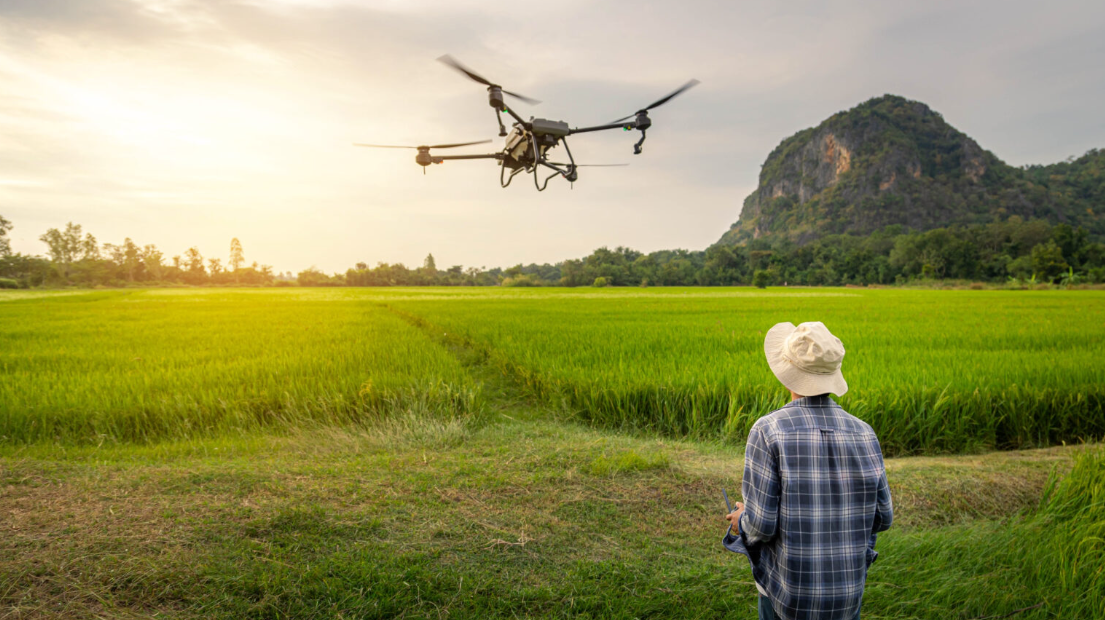
Drones can perform two main types of agricultural tasks. First, mechanical tasks such as sowing seeds, spreading fertilizers and feeds, spraying herbicides, pesticides, and fungicides, or airlifting loads. Second, informational tasks such as counting livestock, mapping and monitoring fields, and generating data to assess crop health and yields.
Most drones are built to do either mechanical or informational tasks, but not both together. They can’t yet automatically adjust the amount of seed, fertilizer, or spray in real time based on crop or field conditions—but this technology is likely to come soon.
Today, drones are already used to apply inputs to a wide range of crops: Grains like rice, maize, and soy; industrial crops such as cotton; fruits like bananas and pineapples; and vegetables. More specialized uses include painting greenhouses, releasing beneficial insects, and airlifting harvested crops.
The most widespread use of drones is for applying pesticides and other crop protectants, followed by spreading fertilizer, and then sowing seed for rice and cover crops.
To understand the scale of this new technology, how many agricultural drones are currently in use around the world?
We conducted online searches in multiple languages to look for information on the number of agricultural drones operational in major agricultural economies.
China leads the world with an estimated 250,000 agricultural drones. Japan and South Korea have some of the highest numbers, relative to their area of agricultural land (~20,000 and ~8,000, respectively). Brazil (12,000), Thailand (~15,000), Turkey (6,000), the United States (~5,500), and Viet Nam (4,000) are some of the fastest-growing markets. Use is also growing in countries including India, Argentina, and Ukraine.
In countries including China, Japan, South Korea, and Thailand, the area serviced by agricultural drones is already equivalent to 30% or more of cropland.
In the U.S., the number of agricultural drones registered with the Federal Aviation Authority jumped from 1,000 in January 2024 to almost 5,500 in July 2025.
How can drones help smallholder farmers in low- and middle-income countries?
There is growing anecdotal—and some scientific—evidence that drones performing mechanical tasks such as spraying crops, sowing rice seeds, and broadcasting fertilizers can:
- Improve efficiency by reducing the amount of input needed per hectare.
- Increase yields by distributing seed, fertilizer, and pesticides more evenly, supporting better growth, and reducing crop damage from heavy ground-based machines.
- Cut energy use compared to large fossil-fuel-powered tractors.
- Lower production costs, contributing to higher farm profitability.
- Save time and labor, easing drudgery, helping older farmers remain active, making agriculture more attractive to youth, and freeing farmers to pursue other employment.
- Improve worker safety by reducing direct exposure to pesticides and herbicides compared with hand spraying.
This emerging evidence suggests that drones have great potential to contribute to sustainable intensification—producing more food with fewer inputs—but we need more systematic research to test and measure these impacts on farms at a large scale.
What are the biggest obstacles to scaling up drone use in agriculture?
This varies from place to place. Some countries have much more restrictive regulatory frameworks than others, and some are very proactive in promoting this technology. That makes a big difference to how quickly drones are adopted, and for what tasks.
How much do agricultural drones cost, and what’s the trend?
Agricultural drone prices have fallen sharply in recent years as technology improved, production scaled up, and competition intensified, especially between the two leading manufacturers, DJI and XAG. One way to measure this is by looking at the cost per kilogram of payload: between 2017 and 2023, that figure dropped about fivefold.
At the same time, drones have been getting larger and more capable. The biggest models on the market today can carry loads of up to 100 kilograms!
Current widely-used drone models might cost around $5,000 in China, but $20,000 or more in the U.S., due to additional costs.
Still, it seems like many poorer smallholder farmers might not be able to afford to buy a drone. Are there any rental services?
Yes, we’ve seen a rapid development of drone rental services recently—offered by some wealthier farmers or small businesses—which allow new adopters to access agricultural drones without spending a lot of money.
The cost of hiring a drone is typically similar to or less than the cost of hiring workers or other machines for the same type of work, making them accessible to most farmers.
Does this mean that drones might potentially displace the jobs of human farm workers? What are other potential risks?
Yes, this risk exists for farm workers currently hired to apply inputs. However, drones are diffusing most rapidly in middle- and high-income countries where farm labor is scarce. In places with abundant labor, there is much less demand, so we wouldn’t expect the displacement effect to be very large.
Other risks include:
- Increased spray drift: Stray pesticides or herbicides are more likely to be carried on the wind to neighboring farms or bystanders compared to conventional ground-based spraying.
- Data security and privacy: Who owns the information collected by drones, where is it stored, who has access to it, and how is it used?
- Technological sovereignty:Does the very concentrated nature of global drone manufacturing create future vulnerabilities to supply chain disruptions, and could drones be affected by cyberattacks?
Regarding future research, what else do we need to know? What are the main knowledge gaps?
Most prior research has been technical, focusing on tasks designed to support precision agriculture. However, drones are not yet widely used by farmers for these purposes. At the same time, much less attention has been given to the use of drones for mechanical tasks—even though these account for the vast majority of current agricultural drone applications globally.
As a result, we still know relatively little about where, how, and to what extent drones are being used in agriculture, as well as their current impacts and potential implications.
New research is needed to better understand the scale and nature of global drone adoption, identify policies that can maximize the benefits and mitigate the risks, and ensure that drones contribute meaningfully to more sustainable agricultural practices.